As we start another year of studies, I invite my students and their families to check out this wonderful database of Jewish music from around the world for Selichot, Rosh Hashanah, and Yom Kippur.
JNUL - Jewish National & University Library
Showing posts with label sephardim. Show all posts
Showing posts with label sephardim. Show all posts
Tuesday, September 27, 2011


Wednesday, December 1, 2010
Hanukkah celebrations and stories from around the world
Be'chol Lashon/In Every Tongue is an organization offering educational resources and programs highlighting the diversity of Jewish customs and practices around the world. They offer here eight bits about Hanukkah as it is practiced by diverse Jewish communities: Chanukah around the World: 8 Ways to Celebrate.
Another custom is practiced in Italy and Yemen--reading a book called Megillat Antiochus.
For more resources on Hanukkah around the world:
Be'chol Lashon: Educational Resources: Holidays: Chanukah
Another custom is practiced in Italy and Yemen--reading a book called Megillat Antiochus.
For more resources on Hanukkah around the world:
Be'chol Lashon: Educational Resources: Holidays: Chanukah
Sunday, October 31, 2010
Actual color photo of Bukharan Jews from a Century Ago
A hundred years ago, a color photo was almost always one that had been hand-tinted (painted). I said "almost always" for a reason. In August, the Boston Globe published an amazing series of actual color photos taken between 1909 and 1912, surveying the Russian Empire. They are truly amazing. Image 16 of the ones published by the Globe shows a rabbi and students in Samarkand, the heart of the Bukharan Jewish community.
To see the rest of the photos, click here:
Russia in color, a century ago - The Big Picture - Boston.com
To learn more about the Uzbek, or Bukharan Jews, see: http://www.jewishvirtuallibrary.org/jsource/History/Bukharan_Jews.html.
Thanks to Jodi Paley for bringing these amazing photos to my attention!
 |
| A group of Jewish children with a teacher in Samarkand, (in modern Uzbekistan), ca. 1910. Google Map, (Prokudin-Gorskii Collection/LOC) # |
To see the rest of the photos, click here:
Russia in color, a century ago - The Big Picture - Boston.com
To learn more about the Uzbek, or Bukharan Jews, see: http://www.jewishvirtuallibrary.org/jsource/History/Bukharan_Jews.html.
Thanks to Jodi Paley for bringing these amazing photos to my attention!
Sunday, September 12, 2010
The Jewish Traveler: Rome - Hadassah Magazine | HadassahMagazine.org
Hadassah Magazine is consistently one of the best Jewish periodicals around. My favorite ongoing feature is The Jewish Traveler. Every month, Hadassah profiles the Jewish community of a city in North America or an international destination. Not only does it inspire dreams of travel, but it also describes the history and culture of the Jews in that area. The Jewish Traveler: Rome - Hadassah Magazine | HadassahMagazine.org
Tuesday, December 2, 2008
Maimonides and the Explusion from Spain
After studying about the Golden Age of Spain, when Jews and Muslims prospered in Moorish Spain, Jen and I introduced the seventh graders to one of the most important Jews of all time: Moses Maimonides, also known as Rambam (acronym for Rabbi Moshe ben Maimon). Rambam fled Spain with his family when the Almohades, a more radical Islamic party, took hold of Spain. Eventually, he settled in Egypt and became that kingdom's most important physician and rabbi. We spoke about Rambam's efforts to simplify Jewish beliefs into thirteen basic principles. My class focused in particular on a number of these beliefs that maintain their relevance in uniting Jews behind common values and practices.
This week, we started learning about the Expulsion from Spain, the 1492 mass exodus of the Jews of Spain (the Sephardim) to new homes in Europe, Asia, North Africa, and the New World. We shared an awesome book--The Cardinal's Snuffbox, a "choose your own adventure" type of book that traces the types of choices and experiences Sephardic Jews encountered in the 15th - 17th centuries. You may want to check it out from a library or purchase it from URJ press (here). The same author wrote several other similar books, set in different periods of Jewish history, that are also worthwhile.
Students may enjoy the following contemporary description of the plight of the Sephardim: First Hand Account of the 1492 Expulsion by an Italian Jew.
This week, we started learning about the Expulsion from Spain, the 1492 mass exodus of the Jews of Spain (the Sephardim) to new homes in Europe, Asia, North Africa, and the New World. We shared an awesome book--The Cardinal's Snuffbox, a "choose your own adventure" type of book that traces the types of choices and experiences Sephardic Jews encountered in the 15th - 17th centuries. You may want to check it out from a library or purchase it from URJ press (here). The same author wrote several other similar books, set in different periods of Jewish history, that are also worthwhile.
Students may enjoy the following contemporary description of the plight of the Sephardim: First Hand Account of the 1492 Expulsion by an Italian Jew.
Monday, November 3, 2008
The Virtual Jewish History Tour - Spain
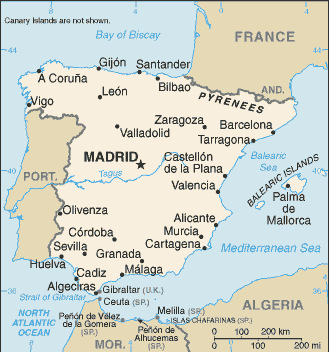
Beginnings of the Jews in Spain, through the period of Muslim Rule,
selected from: The Virtual Jewish History Tour - Spain
Introduction
The history of Spanish Jewry dates back at least two thousand years to when the Romans destroyed the Second Temple in Jerusalem, and brought Jews with them back to Europe. Since that time, the Jews of Spain (Sephardim) have experienced times of great oppression and hardship, as well as periods of unprecedented growth and renewal.
Roman Rule (ca. 205 BCE-Early 5th Century)
While the area of modern-day Spain (formerly a collection of kingdoms which included Castile, Aragon, and Catalonia) was still controlled by the Holy Roman Empire, the Catholic Church convened at the Council of Elvira where they issued 80 canonic decisions, many of which were intended to ostracize the Jews from the general Spanish community. For example, Canon 49 prohibited Jews from blessing their crops, and Canon 50 refused communion to any cleric or layperson that ate with a Jew.
Visigoth Rule (5th Century-711)
During the early 5th century, the Visigoths captured the Iberian Peninsula from Roman rule. While initially anti-Christian, the Visigoths later converted to Christianity and adopted many of the previous laws that existed during Roman rule. Under the rein of Toledo III, children of mixed marriages were forcibly baptized and Jews were barred from holding public office. The situation got progressively worse and, in 613, the Jews were ordered to convert to Christianity or face expulsion. Though many Jews chose to leave rather than convert, a large number of them still practiced Judaism in secret for centuries. In 633, the Fourth Council of Toledo, convened to address the problem of crypto-Judaism (Jews who converted to Christianity to escape persecution, yet observed Jewish law in private. The people who practiced this were also know as Marranos). While opposing compulsory baptism, the Council decided that if a professed Christian was determined to be a practicing Jew, his or her children were to be taken away and raised in monasteries or trusted Christian households.
Muslim Rule (711-11th Century)
In the 8th century, the Berber Muslims (Moors) swiftly conquered nearly all of the Iberian Peninsula. Spain flourished under Muslim rule, and Jews and Christians were granted the protected status of dhimmi. Though this still did not afford them equal rights with Muslims, during this “Golden Age” of Spain, Jews rose to prominence in society, business, and government.
The conditions in Spain improved so much under Muslim rule that Jews from all across Europe came to live in Spain during this Jewish renaissance. There they flourished in business and in the fields of astronomy, philosophy, math, science, medicine, and religious study. The same period also witnessed a resurgence of Hebrew poetry and literature from a traditional and liturgical language to a living language able to be used to describe everyday life. Among the early Hebraists of the time were Yehudah HaLevi who became known as one of the first great Hebrew poets, and Menahem ben Saruq who compiled the first ever Hebrew dictionary.
The intellectual achievements of the Sephardim (Spanish Jews) enriched the lives of non-Jews as well. In addition to contributions of original work, the Sephardim translated Greek and Arabic texts, which proved instrumental in bringing the fields of science and philosophy, much of the basis of Renaissance learning, to the rest of Europe.
In the early 11th century, centralized authority based at Cordoba broke down following the Berber invasion and the ousting of the Umayyads. Rather than having a stifling effect, the disintegration of the caliphate expanded the opportunities to Jewish and other professionals. The services of Jewish scientists, doctors, traders, poets, and scholars were generally valued by the Christian as well as Muslim rulers of regional centers, especially as recently conquered towns were put back in order.
Yet, despite the Jews’ success and prosperity under Muslim rule, the Golden Age of Spain began to decline as the Muslims began to battle the Christians for control of the Iberian Peninsula and Spanish kingdoms in 722. The decline of Muslim authority was matched with a rise in anti-Semitic activity. In 1066, a Muslim mob stormed the royal palace in Granada, crucified Jewish vizier Joseph ibn Naghrela and massacred most of the Jewish population of the city. Accounts of the Granada Massacre state that more than 1,500 Jewish families, numbering 4,000 persons, were murdered in just one day. The conditions of Jews living on the Iberian Peninsula (Spain and Portugal) steadily began to worsen again. As a result, many people started fleeing the Iberian Peninsula to neighboring nations. Among those who fled were the famed bible commentators Abraham Ibn Ezra and Rabbi Yosef Karo (author of the Shulchan Aruch), as well as the families of Maimonides and philosopher Baruch Spinoza.
Monday, October 13, 2008
At the Festival of Sukkot, Cooking Is Identity for Syrian Jews - New York Times

This article (from the New York Times two years ago) describes how New York's Sephardic population celebrates Sukkot. The "Related" box on the left of the screen (when you go to the article at the NY Times website) features recipes for dishes mentioned in the article.
At the Festival of Sukkot, Cooking Is Identity for Syrian Jews - New York Times
Cooking Defines Sephardic Jews at Sukkot
LIKE its trees, Brooklyn’s sukkahs sprout in unlikely places.
All over the borough, observant Jewish families spent the first week of October building sukkahs, outdoor rooms with open roofs, in preparation for the holiday of Sukkot, which began last Friday and ends this Friday. Perched on asphalt roofs and in concrete gardens, they will eat under the stars for a week to commemorate the Jews’ biblical wanderings in the desert.
For one food-loving community within Brooklyn’s sizable Jewish population, Sukkot has additional significance.
“We always cook a lot, but for Sukkot, we do even more,” said Aida Hasson, who grew up in Beirut and is part of Brooklyn’s tight-knit community of Middle Eastern Jews.
This network of a few hundred families shares roots in Syria, Lebanon, Iraq and Egypt, and also an extraordinary culinary tradition. They use the term Syrian Jews, to distinguish themselves within the larger world of the Sephardim, the Jews of the Mediterranean.
“We call ourselves Syrian, Sephardic, Middle Eastern, whatever,” said Giselle Habert, who was born in Cairo. “The important thing is that we all know each other, and we all cook the same things.”
This community’s favorites are labor-intensive dishes that are still passed down from mother to daughter: sambusak, crisp little half-moons stuffed with allspice-scented meat or tangy white cheese; mujadara, lentils and rice cooked together and thickly piled with gold-brown strands of onion; mahshi, vegetables like tiny eggplant and finger-size zucchini stuffed with spiced meat and rice; and kahk, sesame-sprinkled rounds of crumbly pastry.
“Ours is the real, original cooking of the Jews,” said Vicki Maijor, whose grandmother was born in Aleppo, Syria. In the Bible, she pointed out, when Esau sells his birthright, “it is for lentil soup, isn’t it?”
Now spread over the world, “the community,” as its members call it, is defined mostly through family and religion, but also by its distinctive food, so different from the brisket and bagels of the Ashkenazic tradition most Americans are familiar with.
FOR MORE OF THIS ARTICLE, CLICK HERE.
About the image above:Evan Sung for The New York Times
A dessert table includes, from top, sesame rounds called kahk; preserved apples and spaghetti squash; and cactus pear and pomegranate seeds, fall fruits that are traditional for Sukkot.
Wednesday, September 24, 2008
MUSIC VIDEO: Amonai Shamati—Moroccan High Holy Day Piyyut
This beautiful melody is from the Sephardic-Moroccan musical tradition. A piyyut is a prayer in prayer form, usually composed on the specific theme of an older prayer and being chanted before or in the middle of that prayer. This piyyut--asking for God to hear the singer's prayer--is chanted just before the Amidah on both Rosh Hashanah and Yom Kippur.
Tuesday, September 23, 2008
HADASSAH Magazine - Jewish Traveler Archive
Every month, Hadassah Magazine has a terrific article about Jewish life in a particular country or city, remote or close at hand. The articles are terrific resources for travelers and are great resources for learning about Jews around the world but are also fun to just look at.
HADASSAH Jewish Traveler Archive
HADASSAH Jewish Traveler Archive
Jews around the world
Jews around the world
This website has links that describe briefly the history of Jews from countries all over the world.
This website has links that describe briefly the history of Jews from countries all over the world.
Wednesday, October 24, 2007
Maimonides for Seventh Graders
The Jewish Virtual Library has a great article on Rambam. Students missing class on October 24 should read the article (here). There is also an interesting article in the Jewish Encyclopedia on Articles of Faith. Pay particular attention to the Thirteen Articles of Faith of Maimonides.
Rabbi Rochel's Favorite Ladino Song
"Cuando El Rey Nimrod" ("When the King Nimrod...") is a Ladino song about the birth of Abraham. Follow this link to see the lyrics and listen to the song. If you want to read a short explanation of the song and its unusual themes, read the Wikipedia entry. It's my favorite Ladino song. I first heard it sung by the amazing Jewish band Divahn about five or six years ago. You can listen to the song and others like it at CD Baby.
Tuesday, October 9, 2007
Subscribe to:
Comments (Atom)